
Thursday, September 24, 2009

Thursday, September 17, 2009
Parallel Importation of Books
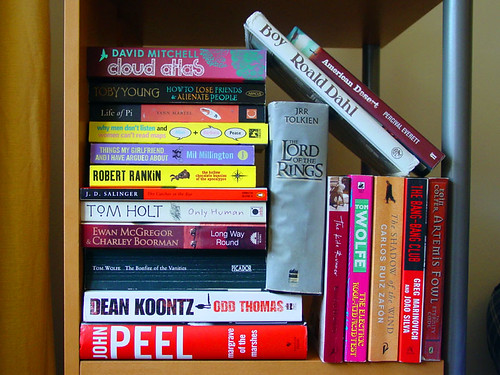
(picture licensed under a CC-BY licence from Ian Wilson)
The Productivity Commission has recommended that the laws enforcing the parallel importation restrictions (PIRs) be repealed.
If Australian publishers meet certain conditions, the Copyright Act 1968 effectively bestows upon them a monopoly in the local book market. Booksellers in Australia are restricted from imported a cheaper version of the book, and must buy it from an Aussie publisher instead (if available).
On the whole, this means that Australian publishers wield considerable market power, and arguably make supernormal profits as a result.
I just bought a book from The Book Depository (UK) for $34.40 plus a $2 international transaction fee on my credit card. The Book Depository charges in pounds and does NOT charge for shipping. At the local second hand book store across the road from my office, the same book goes for $40. At Borders further down the road, it's $59.95. Ouch.
Even if you accounted for foreign currency exchange differences, it seems to me that the Australian book retailers are charging a lot more for these books that our overseas counterparts. Presumably, that's because they have to buy it from Aussie publishers. When it comes to the relationship between booksellers and book publishers, booksellers appear to be the price takers.
An interesting quote from the Senator Carr on Printnet reveals something about these margins (or supernormal profits). He says (and presumably the printing/publishing industry agrees) that the margins the publishers make from best sellers are used to invest in more risky and unknown Australian authors. That is, the (supernormal) profits are used to invest in some authors which produce "cultural externalities" which would otherwise not be commercially successful.
Graeme Connelly (CEO of Melbourne Uni Bookshop) reckons "much of the argumentation by publishers (to the Productivity Commission) has frankly been rent-seeking."
Allan Fels made an interesting remark about the (then) Prices Surveillance Authority 1989 report recommending the repeal of PIRs on books. "It made a terrible mistake. It said there were two problems. Never give a politician two problems. Cos they'll take the easy one and solve it. We said that (a) there was a delay in books getting to Australia and (b) the prices were too high."
In 1991, amendments were passed requiring Australian publishers to supply the books within 30 days of publication in order to receive PIR protection. This solved the delay problem, but did not affect prices.
One other thing about Senator Carr: he thinks that the publishing and printing industry should be *tin foil hat on* "protected" *tin foil hat off* because we need the excess capacity in Australia to ensure the maximum dissemination of ideas. That is, despite the internet providing almost no barriers to dissemination, we still need books (and hence the decision makers and gatekeepers, publishers) to get the ideas out there.
I dunno about that, it might be true, it might not be. Something tells me, if we lift the PIRs, although the publishers can kiss some of their supernormal profits goodbye, they'll be just fine.
Let's maximise consumer surplus!!
Saturday, September 05, 2009
The Gospel and Intellectual Property (rival goods)
I've just finished reading "The Future of Ideas", a not so recent book by Lawrence Lessig. It talks about rivalrous goods and non-rivalrous goods.
A rivalrous good is one where my use of the good (say, a car), will rival your use of the same car. We cannot drive it at the same time. Most physical objects are rivalrous to some extent. A public park is non-rivalrous, until it gets really crowded, when my use and enjoyment of the park is negatively affected by your (and the thousand other people) use of the park. It will then become rivalrous.
Intellectual property, and knowledge in general, has the character of being non-rivalrous. If I learn something from you, say a recipe for chocolate brownies, you do not need to unlearn it. My use of the recipe does not rival your use of the recipe. Although, if we shared one oven, hopefully we can use the same recipe, otherwise the use of the oven will be rivalrous!
ANYWAY... I was thinking about the Gospel (aka Good News), and how people tell other people about Jesus. One of the great things about the good news of Jesus, is that, if I know it in my head, I can tell you all about Jesus. I do not need a leaflet, or a pamphlet or a bookmark to tell you about it. Leaflets may be finite (and their use rivalrous), but the gospel itself is not rivalrous. Millions of people tell millions of other people about Jesus all the time, and the gospel will never diminish in it power.
Interestingly enough, one might say that the act of telling people about Jesus, actually enhances my ability to tell more people. Like they say, practice makes perfect. Also, websites tend to be regarded as non-rivalrous, as MANY people can visit a website at a time. Although they do have their limits, as Denial of Service attacks can overwhelm a website by visiting it from many computers simultaneously.
So, non-rivalrous news (the good news about Jesus), from an almost non-rivalrous source (a website) - try Two Ways to Live.
A rivalrous good is one where my use of the good (say, a car), will rival your use of the same car. We cannot drive it at the same time. Most physical objects are rivalrous to some extent. A public park is non-rivalrous, until it gets really crowded, when my use and enjoyment of the park is negatively affected by your (and the thousand other people) use of the park. It will then become rivalrous.
Intellectual property, and knowledge in general, has the character of being non-rivalrous. If I learn something from you, say a recipe for chocolate brownies, you do not need to unlearn it. My use of the recipe does not rival your use of the recipe. Although, if we shared one oven, hopefully we can use the same recipe, otherwise the use of the oven will be rivalrous!
ANYWAY... I was thinking about the Gospel (aka Good News), and how people tell other people about Jesus. One of the great things about the good news of Jesus, is that, if I know it in my head, I can tell you all about Jesus. I do not need a leaflet, or a pamphlet or a bookmark to tell you about it. Leaflets may be finite (and their use rivalrous), but the gospel itself is not rivalrous. Millions of people tell millions of other people about Jesus all the time, and the gospel will never diminish in it power.
Interestingly enough, one might say that the act of telling people about Jesus, actually enhances my ability to tell more people. Like they say, practice makes perfect. Also, websites tend to be regarded as non-rivalrous, as MANY people can visit a website at a time. Although they do have their limits, as Denial of Service attacks can overwhelm a website by visiting it from many computers simultaneously.
So, non-rivalrous news (the good news about Jesus), from an almost non-rivalrous source (a website) - try Two Ways to Live.
Saturday, July 25, 2009
A new nerd convergence: MAKE and copyright
And you thought taxified Harry Potter titles were an unholy nerd alliance? As it turns out (from SMH) Amazon, who sell the Kindle and the e-books that are read on it, made a booboo. It turns out that they were selling books by George Orwell (like 1984), but after they were sold and downloaded to individuals' Kindle, it turned out they didn't have the rights to do so, and Amazon apparently snuck in, and deleted the e-books from everyone's Kindles and refunded the money, without decent notification.
Enter MAKE, a print and online magazine dedicated to DIY and lots of cool nerd stuff like electronics. For example, there are LOTS of Wiimote hacks on Make. KipKay, a popular online DIYer regularly makes videos for MAKE. Very cool - for example:
Anyway, it seems MAKE have published (through their blog) a "workaround" in order to get the Orwellian books back on the Kindle. "How?" you ask? One word, "copyright". In Australia, Orwell's books have entered the Public Domain because copyright in Australia (for literary works anyway) is life of author plus 50 years. In the US (where Amazon wasn't allowed to sell the books) the term is life of author plus 70 years. Nothing quite like a bit of copyright arbitrage. Of course, you actually HAVE to be in Australia to download the book (from an Aussie Uni site). A US resident will probably still be infringing copyright if they carry out the workaround unless they're in Australia.
Read the MAKE "workaround" here.
Enter MAKE, a print and online magazine dedicated to DIY and lots of cool nerd stuff like electronics. For example, there are LOTS of Wiimote hacks on Make. KipKay, a popular online DIYer regularly makes videos for MAKE. Very cool - for example:
Anyway, it seems MAKE have published (through their blog) a "workaround" in order to get the Orwellian books back on the Kindle. "How?" you ask? One word, "copyright". In Australia, Orwell's books have entered the Public Domain because copyright in Australia (for literary works anyway) is life of author plus 50 years. In the US (where Amazon wasn't allowed to sell the books) the term is life of author plus 70 years. Nothing quite like a bit of copyright arbitrage. Of course, you actually HAVE to be in Australia to download the book (from an Aussie Uni site). A US resident will probably still be infringing copyright if they carry out the workaround unless they're in Australia.
Read the MAKE "workaround" here.
Thursday, July 23, 2009
The Lazy Susan Code of Conduct

For those unaware, myself and others have authored the "Principles of Yum Cha", otherwise known as 'The Yum-Charter". Principle 23 refers to the 'Lazy Susan Code of Conduct'.
Here it is, a living document, if you will:
The Lazy Susan Code of Conduct
1. Subject to the below clauses, the Lazy Susan ('LS') shall be revolved as fast as is necessary to eat Yum Cha.
2. If someone is retrieving a dim sim from the LS, you shall not revolve the LS to the extent that the retriever has difficulty retrieving the dim sim.
3. As a matter of best practice, you shall wait until the retriever has retrieved their dim sim before revolving the LS.
4. Chilli sauce saucers shall be distributed evenly on the LS.
5. Depending on circumstances, empty bamboo baskets shall be placed in the centre of the LS, OR on a part of the table close to trolley traffic.
6. The LS shall not be spun so fast as to cause any objects on the LS to move, or any sauce in saucers on the LS to spill.
Any others that should be there?

Censordyne and the Parody/Satire Exception
In case you haven't already noticed, the independent political campaigning group GetUp! have launched a TV ad against the Australian Governments plans for mandatory ISP level filtering of the Internet. They use the likness of the packaging for Sensodyne toothpaste and have called it Censordyne "good, clean, internet censorship".
SMH story here.
Apparently, GlaxoSmithKlein (owner of Sensodyne), is not a fan of GetUp's use of the likeness of the toothpaste brand. They are even thinking of legal action, as they weren't consulted about the use of the brand.
The first thing I think of is the parody and satire exception to copyright infringement in section 41A of the Copyright Act 1968. Basically, you can reproduce a substantial part of a work, and avoid infringement if:
* it is for the purpose of parody or satire; and
* it is a fair dealing
I suppose the question is, (and I couldn't find anything in the Explanatory Memorandum in the amending Act which introduced s41A):
Does the parody have to be a poking fun at the thing being reproduced? That is, does the exception only apply if GetUp were in fact poking fun at the toothpaste rather than something else like a Government policy?
If you remembered the anti-ads by the Footy Show, those were poking fun at the ads themselves, so it's an obvious parody. But if you are using a toothpaste brand to poke fun at policy, is that covered by the exception?
Then you have to consider the satire part of the exception. The Australian Copyright Council (fact sheet G083v03) makes a distinction between parody and satire, and regards the satire exception to be more strict in the sense that more elements have to be present before one can regard it as "satire".
Food for thought.
SMH story here.
Apparently, GlaxoSmithKlein (owner of Sensodyne), is not a fan of GetUp's use of the likeness of the toothpaste brand. They are even thinking of legal action, as they weren't consulted about the use of the brand.
The first thing I think of is the parody and satire exception to copyright infringement in section 41A of the Copyright Act 1968. Basically, you can reproduce a substantial part of a work, and avoid infringement if:
* it is for the purpose of parody or satire; and
* it is a fair dealing
I suppose the question is, (and I couldn't find anything in the Explanatory Memorandum in the amending Act which introduced s41A):
Does the parody have to be a poking fun at the thing being reproduced? That is, does the exception only apply if GetUp were in fact poking fun at the toothpaste rather than something else like a Government policy?
If you remembered the anti-ads by the Footy Show, those were poking fun at the ads themselves, so it's an obvious parody. But if you are using a toothpaste brand to poke fun at policy, is that covered by the exception?
Then you have to consider the satire part of the exception. The Australian Copyright Council (fact sheet G083v03) makes a distinction between parody and satire, and regards the satire exception to be more strict in the sense that more elements have to be present before one can regard it as "satire".
Food for thought.
Wednesday, July 22, 2009
Harry Potter: the taxified version
My colleagues asked me the other day whether I had read any Harry Potter books. I didn't, not because I don't like Harry Potter, but because I generally read non-fiction books. I speculated, however, whether I would be more willing to read Harry Potter if the titles were something like "Harry Potter and the Tax Act".
We then sought to "taxify" the titles of the Harry Potter books. I don't know how to write "markup style" text, so I've done it in Word, and made it a PNG file. Here are the results: (the blue text was written by me afterwards, so I take responsibilty for the lameness of the sub-titles).

We then sought to "taxify" the titles of the Harry Potter books. I don't know how to write "markup style" text, so I've done it in Word, and made it a PNG file. Here are the results: (the blue text was written by me afterwards, so I take responsibilty for the lameness of the sub-titles).

Monday, July 20, 2009
P2P - a legit business model?
Let's face it, P2P file-sharing arguably presents the biggest leakage to copyright revenue for traditional professional content, like music, movies and computer games. In Australia, iiNet is being sued by Roadshow Films (with backing from AFACT). Case ref: [2009] FCA 332.
Roadshow alleges:
* by a user making available a movie file via BitTorrent, the user is making the movie available to the public, thus infringing the "right to communicate to the public".
* by downloading a copy of the film onto their computer, the user has infringing the "reproduction right".
* by providing the facilities for this infringement, iiNet has authorised the infringement, which is an act of infringement itself.
So, in this case, the copyright holder (Roadshow) is probably sick of chasing down each and every infringer (the evidence submitted indicated that Roadshow had enough information to identify the infringers but wanted iiNet to do something about it [i.e. disconnect them]), and wants the ISP to take action, and failing that, the copyright holders takes action against the ISP.
Meanwhile, on the otherside of the world, The Pirate Bay is trying to get a legit business model up and running supporting the P2P method of file sharing.
SMH report here.
If this Pirate Bay thing works out (which in my pessimistic mind, it won't), maybe everyone around the world, including Australia and New Zealand can stop worrying about the "three-strikes and you're disconnected" idea that's been floating around for a while now. New Zealand tried it, and had to pike after a public outcry.
Story stub here.
(I love this site, they've disabled selecting text, it's a copyright holders site, how funny!)
Roadshow alleges:
* by a user making available a movie file via BitTorrent, the user is making the movie available to the public, thus infringing the "right to communicate to the public".
* by downloading a copy of the film onto their computer, the user has infringing the "reproduction right".
* by providing the facilities for this infringement, iiNet has authorised the infringement, which is an act of infringement itself.
So, in this case, the copyright holder (Roadshow) is probably sick of chasing down each and every infringer (the evidence submitted indicated that Roadshow had enough information to identify the infringers but wanted iiNet to do something about it [i.e. disconnect them]), and wants the ISP to take action, and failing that, the copyright holders takes action against the ISP.
Meanwhile, on the otherside of the world, The Pirate Bay is trying to get a legit business model up and running supporting the P2P method of file sharing.
SMH report here.
If this Pirate Bay thing works out (which in my pessimistic mind, it won't), maybe everyone around the world, including Australia and New Zealand can stop worrying about the "three-strikes and you're disconnected" idea that's been floating around for a while now. New Zealand tried it, and had to pike after a public outcry.
Story stub here.
(I love this site, they've disabled selecting text, it's a copyright holders site, how funny!)
Someone got causation and correlation mixed up again!
SMH reports that a visiting US professor reckons that KRudd's computers in homes strategy maybe counter productive.
SMH report here.
The report essentially says that "Yes, kids with computers at home tend to do better at school, that is, there is a CORRELATION between home computers and academic achievement." BUT the more important qualifier is that computers at home do not CAUSE kids to do better academically.
That is, a child might do better academically because their PARENTS are more educated or more well off, and these parents are also likely to have a computer at home. That is, A and B (academic achievement and computers) are caused by C (parents' background). Not B causes A.
Therefore, if you simply introduce B into a house (computers), it may not affect C (parents) who are ultimately the main cause of academic achievement (A).
This is exactly the thing that happened a while back in the US. According to Freakonomics (the book, not the blog), some President promised free books in the homes of every school kid because studies had shown that academic achievers at school tended to have more books at home. What the study didn't show was that the achievement may have been due to the parents' educational background. It was this background which caused both the child's academic achievement, and the number of books in the house.
Surprise, surprise, when the books arrived, nothing happened, because books don't cause academic achievement.
So, will the same thing happen with free or taxpayer subsidised computers in Aussie homes? Professor Vigdor says that in North Carolina, the introduction of computers actually made the results of some school students "significantly worse."
Are we ready for a taxpayer funded education devolution?
SMH report here.
The report essentially says that "Yes, kids with computers at home tend to do better at school, that is, there is a CORRELATION between home computers and academic achievement." BUT the more important qualifier is that computers at home do not CAUSE kids to do better academically.
That is, a child might do better academically because their PARENTS are more educated or more well off, and these parents are also likely to have a computer at home. That is, A and B (academic achievement and computers) are caused by C (parents' background). Not B causes A.
Therefore, if you simply introduce B into a house (computers), it may not affect C (parents) who are ultimately the main cause of academic achievement (A).
This is exactly the thing that happened a while back in the US. According to Freakonomics (the book, not the blog), some President promised free books in the homes of every school kid because studies had shown that academic achievers at school tended to have more books at home. What the study didn't show was that the achievement may have been due to the parents' educational background. It was this background which caused both the child's academic achievement, and the number of books in the house.
Surprise, surprise, when the books arrived, nothing happened, because books don't cause academic achievement.
So, will the same thing happen with free or taxpayer subsidised computers in Aussie homes? Professor Vigdor says that in North Carolina, the introduction of computers actually made the results of some school students "significantly worse."
Are we ready for a taxpayer funded education devolution?
Tuesday, July 07, 2009
A random thought about DRM
DRM is Digital Rights Management. It is the technology implemented by content creators and distributors which technologically enforce the limits of rights granted to the licensee.
Sometimes you can get content without DRM. For example, if I buy a CD from JB Hi-Fi, the licence would mean I could play it at home, but not publicly. I would also be not permitted to copy this CD (the right to reproduce is 'reserved' by the artist or the recording studio etc). According to copyright law (sect 109A Copyright Act 1968), however, I CAN (no matter what the recording studio says) rip the CD to my computer (thus converting it from PCM to MP3), and transferring it to my iPod.
Furthermore, despite the restrictions described by the licence (for example, not being allowed to make 100 copies to give to my friends), there is nothing physically stopping me from doing it.
This is content without DRM. The licence and the law say you can and can't do certain things. Physically, though, (whether legally or illegally) I can do anything I want with it.
Enter DRM:
For example, say I buy a song from iTunes, and the licence to that song says that I (the licensee) can:
* play this song on 5 authorised computers, and
* play this on iPods registered to me
* burn this song to CD 3 times.
Once I burn the song onto CD 3 times, it will no longer burn to another CD. iTunes will recognise what's already happened to the song and prevent the burning. Furthermore, if I email the M4A song file to a friend, he won't be able to play the song (which MUST be iTunes) until he enters my username and password, thus authorising his computer in my name. Again, the file itself, in combination with the player (iTunes) actually physically control what I can do with the file. That is, the DRM technology physically limits which I can do in accordance with the licence.
In this sense, the licence and the law say what I can and can't do, and the DRM controls what I can and can't do in accordance with the licence (even if the law says I might be allowed to do something else beyond the licence permissions).
My question is, why bother with DRM? Isn't the law and licensing enough to protect the interests of copyright holders? Aren't all consumers law abiding citizens? Okay, maybe not. In acknowledging and conceding that THE LAW AND LICENCE IS NOT ENOUGH to guide the behaviour of some consumers (i.e. the 'pirates' argh), copyright holders implement measures (DRM) to physically (rather than legally) 'guide' the behaviour of those consumers.
DRM measures are now protected by law. Section 116AN will treat someone who circumvents a technological protection measure (TPM, the legal, generic reference to DRM) as if they had infringed the copyright holder's rights (e.g. copying etc).
But my question is, why bother protecting DRM with law? Law and licence doesn't guide the behaviour of pirates. That's why we have DRM in the first place. So it seems logical to assume that pirates aren't going to have regard to the law when it comes to circumventing a TPM. If an iTunes song holder wants to burn a 4th CD of the song, they'll just rip one of the CD's they burnt before. Burnt CD's are DRM free (just like the ones from JB Hi-Fi).
So why have a legal regime (s116AN/TPMs) designed to protect a technological regime (DRM) designed to protect another legal regime (copyright licenses and statutory exceptions), when pirates don't respect the copyright licencing regime in the first place?
This seems silly to me, and this is without even considering the fact that DRM has the potential to:
* stifle innovation
* restrict competition (iTunes and iPod are dominant for more reasons than the style of the iPod)
* prevent a consumer from exercising their extra-licence fair use/dealing statutory rights.
What are your thoughts? It seems to me that the marketplace is in need of another regime to protect the rights of copyright holders, without making life supremely difficult for everyone else (whilst at the same time undermining the respect people have for the law)**.
** According to the Australian Copyright Councils Information Sheet G25 TV and Radio: home taping ("time-shifting"):
Q: Can I record programs that I'm watching or listening to so that I can enjoy them again later?
A: NO, You can only record programs that you are NOT watching or listening to. This is because the new time-shift provision says that you can only make the recording in order to watch it or listen to it "at a time more convenient than the time when the broadcast is made" Section 111.
I wonder what happens if I decide to record NCIS tonight on tape, and instead of changing channels or going to bed, I decide to watch the first 5 minutes while it's recording and then go to bed. Uh oh....
Sometimes you can get content without DRM. For example, if I buy a CD from JB Hi-Fi, the licence would mean I could play it at home, but not publicly. I would also be not permitted to copy this CD (the right to reproduce is 'reserved' by the artist or the recording studio etc). According to copyright law (sect 109A Copyright Act 1968), however, I CAN (no matter what the recording studio says) rip the CD to my computer (thus converting it from PCM to MP3), and transferring it to my iPod.
Furthermore, despite the restrictions described by the licence (for example, not being allowed to make 100 copies to give to my friends), there is nothing physically stopping me from doing it.
This is content without DRM. The licence and the law say you can and can't do certain things. Physically, though, (whether legally or illegally) I can do anything I want with it.
Enter DRM:
For example, say I buy a song from iTunes, and the licence to that song says that I (the licensee) can:
* play this song on 5 authorised computers, and
* play this on iPods registered to me
* burn this song to CD 3 times.
Once I burn the song onto CD 3 times, it will no longer burn to another CD. iTunes will recognise what's already happened to the song and prevent the burning. Furthermore, if I email the M4A song file to a friend, he won't be able to play the song (which MUST be iTunes) until he enters my username and password, thus authorising his computer in my name. Again, the file itself, in combination with the player (iTunes) actually physically control what I can do with the file. That is, the DRM technology physically limits which I can do in accordance with the licence.
In this sense, the licence and the law say what I can and can't do, and the DRM controls what I can and can't do in accordance with the licence (even if the law says I might be allowed to do something else beyond the licence permissions).
My question is, why bother with DRM? Isn't the law and licensing enough to protect the interests of copyright holders? Aren't all consumers law abiding citizens? Okay, maybe not. In acknowledging and conceding that THE LAW AND LICENCE IS NOT ENOUGH to guide the behaviour of some consumers (i.e. the 'pirates' argh), copyright holders implement measures (DRM) to physically (rather than legally) 'guide' the behaviour of those consumers.
DRM measures are now protected by law. Section 116AN will treat someone who circumvents a technological protection measure (TPM, the legal, generic reference to DRM) as if they had infringed the copyright holder's rights (e.g. copying etc).
But my question is, why bother protecting DRM with law? Law and licence doesn't guide the behaviour of pirates. That's why we have DRM in the first place. So it seems logical to assume that pirates aren't going to have regard to the law when it comes to circumventing a TPM. If an iTunes song holder wants to burn a 4th CD of the song, they'll just rip one of the CD's they burnt before. Burnt CD's are DRM free (just like the ones from JB Hi-Fi).
So why have a legal regime (s116AN/TPMs) designed to protect a technological regime (DRM) designed to protect another legal regime (copyright licenses and statutory exceptions), when pirates don't respect the copyright licencing regime in the first place?
This seems silly to me, and this is without even considering the fact that DRM has the potential to:
* stifle innovation
* restrict competition (iTunes and iPod are dominant for more reasons than the style of the iPod)
* prevent a consumer from exercising their extra-licence fair use/dealing statutory rights.
What are your thoughts? It seems to me that the marketplace is in need of another regime to protect the rights of copyright holders, without making life supremely difficult for everyone else (whilst at the same time undermining the respect people have for the law)**.
** According to the Australian Copyright Councils Information Sheet G25 TV and Radio: home taping ("time-shifting"):
Q: Can I record programs that I'm watching or listening to so that I can enjoy them again later?
A: NO, You can only record programs that you are NOT watching or listening to. This is because the new time-shift provision says that you can only make the recording in order to watch it or listen to it "at a time more convenient than the time when the broadcast is made" Section 111.
I wonder what happens if I decide to record NCIS tonight on tape, and instead of changing channels or going to bed, I decide to watch the first 5 minutes while it's recording and then go to bed. Uh oh....
Friday, March 28, 2008
Graduation photos
If you're looking for graduation photos, scroll down after the article about Easter.
Why Easter is like Company Tax
When I say the word “imputation”, what do you think of? ‘Franking credits’ or ‘Jesus’? Well, it can be both!
The company tax system passes on ‘franking credits’ to its shareholders. Shareholders are effectively given an income tax credit for the income tax paid by the company in which they are a shareholder. Let’s say Company XYZ makes $100 profit. It pays $30 company tax (company tax rate = 30%), leaving $70 profit after tax.
Imagine now that Company XYZ has one shareholder, Tim. Company XYZ pays Tim a $70 dividend. Attached to that dividend will be a $30 franking credit. Some people call it an imputation credit. In Tim’s individual tax return, he’ll include the $70 dividend as assessable income, AND the $30 franking credit as assessable income. That totals $100.
Assume that Tim has lots of other money coming in and that his marginal tax rate is 30%. The tax on his dividend and credit is $30. Since Tim has a franking credit $30, it will reduce the tax payable on the dividend back to $0. That is, the company has effectively paid Tim’s tax bill on his dividend.
To put it another way, the tax the company has already paid through the company tax system has been IMPUTED to Tim instead. That is, the company tax has been CREDITED to Tim. That’s why it’s called the imputation system.
In some ways, the company is really the shareholder’s representative when it comes to paying tax, despite the fact of it being a separate legal entity. The company tax system merely brings forward a tax payment to Consolidated Revenue rather than waiting for a shareholder to pay the tax when they lodge a tax return.
Okay, so what does this all have to do with Easter and Jesus and stuff?
Firstly, a quote from the Bible:
2 Corinthians 5:21 (NIV)
“God made him (i.e. Jesus) who had no sin to be sin for us, so that in him we might become the righteousness of God.”
When Jesus died on the cross, he was actually acting as our substitute and representative. On the cross, he dealt with the problem of our sin (i.e. our rejection of and rebellion against God). That is, he paid the penalty of our sin (i.e. death and God-forsakenness). In other words, our debt is transferred to him, and he pays it.
The second part of that Bible quote is about us becoming the “righteousness of God”. What this means is that we have our previously very bad relationship (remember the rebellion?) restored. That is, because of Jesus’ death on the cross, we can have a right relationship with God. The presumption is that Jesus was sinless and already had a right relationship with God; “him who had no sin”.
This status of a right relationship (i.e. ‘righteousness’) is credited to us, or imputed to us. That is, we have the status of being righteous, when we well know that we are far from righteous. Everyone has rebelled against God in some way. (Romans 3:9-20)
Company Tax = Easter
In many ways, the company tax imputation systems provides a useful illustration to explain some key points about Easter and the meaning of Jesus’ death on the cross. Those who don’t pay the liability are treated as though they have paid it. This is only possible because someone else has paid it on their behalf.
Company Tax ≠Easter
There’s one important thing that company tax won’t tell you: Jesus didn’t stay dead. The big idea behind Easter is that Jesus rose again (i.e. the resurrection). Do you really think we’d have a 4 day long weekend in honour of some 33 year old ‘moral teacher’ that died and stayed dead? If we did, we'd never go to work.
The company tax system passes on ‘franking credits’ to its shareholders. Shareholders are effectively given an income tax credit for the income tax paid by the company in which they are a shareholder. Let’s say Company XYZ makes $100 profit. It pays $30 company tax (company tax rate = 30%), leaving $70 profit after tax.
Imagine now that Company XYZ has one shareholder, Tim. Company XYZ pays Tim a $70 dividend. Attached to that dividend will be a $30 franking credit. Some people call it an imputation credit. In Tim’s individual tax return, he’ll include the $70 dividend as assessable income, AND the $30 franking credit as assessable income. That totals $100.
Assume that Tim has lots of other money coming in and that his marginal tax rate is 30%. The tax on his dividend and credit is $30. Since Tim has a franking credit $30, it will reduce the tax payable on the dividend back to $0. That is, the company has effectively paid Tim’s tax bill on his dividend.
To put it another way, the tax the company has already paid through the company tax system has been IMPUTED to Tim instead. That is, the company tax has been CREDITED to Tim. That’s why it’s called the imputation system.
In some ways, the company is really the shareholder’s representative when it comes to paying tax, despite the fact of it being a separate legal entity. The company tax system merely brings forward a tax payment to Consolidated Revenue rather than waiting for a shareholder to pay the tax when they lodge a tax return.
Okay, so what does this all have to do with Easter and Jesus and stuff?
Firstly, a quote from the Bible:
2 Corinthians 5:21 (NIV)
“God made him (i.e. Jesus) who had no sin to be sin for us, so that in him we might become the righteousness of God.”
When Jesus died on the cross, he was actually acting as our substitute and representative. On the cross, he dealt with the problem of our sin (i.e. our rejection of and rebellion against God). That is, he paid the penalty of our sin (i.e. death and God-forsakenness). In other words, our debt is transferred to him, and he pays it.
The second part of that Bible quote is about us becoming the “righteousness of God”. What this means is that we have our previously very bad relationship (remember the rebellion?) restored. That is, because of Jesus’ death on the cross, we can have a right relationship with God. The presumption is that Jesus was sinless and already had a right relationship with God; “him who had no sin”.
This status of a right relationship (i.e. ‘righteousness’) is credited to us, or imputed to us. That is, we have the status of being righteous, when we well know that we are far from righteous. Everyone has rebelled against God in some way. (Romans 3:9-20)
Company Tax = Easter
In many ways, the company tax imputation systems provides a useful illustration to explain some key points about Easter and the meaning of Jesus’ death on the cross. Those who don’t pay the liability are treated as though they have paid it. This is only possible because someone else has paid it on their behalf.
Company Tax ≠Easter
There’s one important thing that company tax won’t tell you: Jesus didn’t stay dead. The big idea behind Easter is that Jesus rose again (i.e. the resurrection). Do you really think we’d have a 4 day long weekend in honour of some 33 year old ‘moral teacher’ that died and stayed dead? If we did, we'd never go to work.
Thursday, March 27, 2008
They grow up so quickly....
*sniffles*
Today's grads and cadets who have finished their respective development programs. Special Guest: The Commish.
The shot with five people is the cadets with the Commish.
Apologies for the graininess. I turned off the flash and the camera automatically cranks up the ISO, hence the excessive digital noise.
I used Picasa to tidy it up a bit.
I HAVE REMOVED THESE PHOTOS. IF YOU WANT A COPY, EMAIL ME.
Today's grads and cadets who have finished their respective development programs. Special Guest: The Commish.
The shot with five people is the cadets with the Commish.
Apologies for the graininess. I turned off the flash and the camera automatically cranks up the ISO, hence the excessive digital noise.
I used Picasa to tidy it up a bit.
I HAVE REMOVED THESE PHOTOS. IF YOU WANT A COPY, EMAIL ME.
Friday, February 22, 2008
Poor Form
Wow - it's been August since my last post. Hopefully I'll think of something to put here soon.
Wednesday, August 29, 2007
Swiss Train Video
Here is a video of our train ride. We are in a tunnel, and are getting out.
I hope this works.
I hope this works.
Paris
Hey, guess what, BJ and I met up with...
oh wait, I'll give you some time to guess first.
Okay.
BJ and I met up with Kev Chan in Paris the other day. It was a lot of fun. I tell you what, Kev lives on the edge when it comes to travel. Anyway, we saw lots of things: Notre Dame, Montparnasse Tower, St. Germain Des-Pres, The Sacred Heart, and just a lot of walking around.
Montparnasse Tower is the only skyscraper built within the Paris city-walls. It's quite low rise across all Paris, and the only 2 tall things are the Montparnasse Tower (its really a big building) and the Eiffel Tower.
The tour guide said it was better than the Eiffel Tower because:
a) You can see as much as you would if you were on the Eiffel Tower
b) You can see the Eiffel Tower
c) You can't see the Montparnasse Tower
d) It's cheaper to go up than the Eiffel Tower
e) The queue is shorter than the Eiffel Tower
f) There are less people at the base of the Montparnasse Tower trying to sell you keyrings.
Anyway, here is a picture that BJ took of Kev and I at the top of Montparnasse Tower:

Ahh... it's getting late. I might just publish this now. Just in case I fall asle...
oh wait, I'll give you some time to guess first.
Okay.
BJ and I met up with Kev Chan in Paris the other day. It was a lot of fun. I tell you what, Kev lives on the edge when it comes to travel. Anyway, we saw lots of things: Notre Dame, Montparnasse Tower, St. Germain Des-Pres, The Sacred Heart, and just a lot of walking around.
Montparnasse Tower is the only skyscraper built within the Paris city-walls. It's quite low rise across all Paris, and the only 2 tall things are the Montparnasse Tower (its really a big building) and the Eiffel Tower.
The tour guide said it was better than the Eiffel Tower because:
a) You can see as much as you would if you were on the Eiffel Tower
b) You can see the Eiffel Tower
c) You can't see the Montparnasse Tower
d) It's cheaper to go up than the Eiffel Tower
e) The queue is shorter than the Eiffel Tower
f) There are less people at the base of the Montparnasse Tower trying to sell you keyrings.
Anyway, here is a picture that BJ took of Kev and I at the top of Montparnasse Tower:

Ahh... it's getting late. I might just publish this now. Just in case I fall asle...
Monday, August 27, 2007
Montreux - chocolate hangover
I was very close to leaving BJ behind in Montreux. She liked the placed so much, I was afraid that she didn't want to leave.
Funny story, there is a casino in Montreux. Montreux sounds like a nice place, right? You'd think the casino would be a flash, trendy place right? Well, not in Montreux. After dressing up nicely, we arrived at what could be described as "Hornsby RSL but not as nice". I think the Irish Pub at Asquith Leagues might even be a toe ahead.
The casino was signposted with a CASINO sign, in red neon lights. We were a little let down. The food, however, redeemed the institution. We didn't even take a picture of the place. Sorry. What, hang on, BJ DID take a photo of it. Ooops. Here it is in the day light:

But do you know what was cool? The train ride there was something else. We took a "panoramic" train ride from Lucerne to Montreux. We were at the front of the train. "The front?" you ask. Yes:


Cool huh?
We also took the liberty of paying a visit to the Nestle/Cailler factory. Free samples. BJ enjoyed it, and I managed to exhaust a vial of lactase pills in one hit.


We also stopped by an old castle in a place called Gruyere. They have a cheese factory, but they also have a castle. Check out the view from the castle:

After Montreux, we went to Paris. I'll blog that later. We're in Amsterdam right now.
We met up with Kevin Chan in Paris. His blog is http://inkev.blogspot.com/ hopefully he'll updated it before us, so you can have a look see about Paris.
Funny story, there is a casino in Montreux. Montreux sounds like a nice place, right? You'd think the casino would be a flash, trendy place right? Well, not in Montreux. After dressing up nicely, we arrived at what could be described as "Hornsby RSL but not as nice". I think the Irish Pub at Asquith Leagues might even be a toe ahead.
The casino was signposted with a CASINO sign, in red neon lights. We were a little let down. The food, however, redeemed the institution. We didn't even take a picture of the place. Sorry. What, hang on, BJ DID take a photo of it. Ooops. Here it is in the day light:

But do you know what was cool? The train ride there was something else. We took a "panoramic" train ride from Lucerne to Montreux. We were at the front of the train. "The front?" you ask. Yes:


Cool huh?
We also took the liberty of paying a visit to the Nestle/Cailler factory. Free samples. BJ enjoyed it, and I managed to exhaust a vial of lactase pills in one hit.


We also stopped by an old castle in a place called Gruyere. They have a cheese factory, but they also have a castle. Check out the view from the castle:

After Montreux, we went to Paris. I'll blog that later. We're in Amsterdam right now.
We met up with Kevin Chan in Paris. His blog is http://inkev.blogspot.com/ hopefully he'll updated it before us, so you can have a look see about Paris.
Friday, August 24, 2007
Montreux
BJ broke the "world's most photos taken in one day" record.
We'll need to wade through the photos to find some pithy-ergo-blog-worthy shots to post here.
In the meantime, it's 2:30am here in Paris, and I should really be going to bed.
Bye for now.
We'll need to wade through the photos to find some pithy-ergo-blog-worthy shots to post here.
In the meantime, it's 2:30am here in Paris, and I should really be going to bed.
Bye for now.
Lucerne (or Luzern)

The picture is the view from our hostel room in the late arvo. Not bad huh? Lucerne is a smallish town in Swizterland, where the people mainly speak German first, then French, then English. The town has a river running right through the middle (the Reuss River), flowing from Lake Lucerne, through goodness knows where to eventually end up in the Rhine River. The river flows really quickly, and I'd say that if you fell into it, you'd have buckley's chances of saving yourself. (you'd probably get hypothermia first).
The weather is cool and fresh, a welcome change from the hot and humid weather of Rome and Venice. Lucerne is a small town, and there wasn't much to see except for landscapes. Plenty to see in terms of mountains etc. There are several bridges crossing the river, and one of them is a big old wooden one, and the picture below was taken from it. As you can see, its got lots of flowers lining it. They really like flowers here.

It was cool having a river racing past outside your hostel window. Just the novelty I suppose. The place seems really laid back too. Not over-populated by neither citizens, tourists or traffic.
Oh yeah, if you DO fall in the river, your best bet is to be save by someone wielding this hook.

Also, there are lots of ducks and swannings paddling about in the River. How they get from one side to the other without being swept away beats me. Anyway, you already know what a swan looks like. But do you know what a swan looks like when its getting food from the river bed?

Subscribe to:
Posts (Atom)