This is just a list of software you can use to get the Wiimote Whiteboard working:
Johnny Chung Lee's original Wiimote Whiteboard program: http://johnnylee.net/projects/wii/ - FREE - once you have connected the wiimote to the computer via bluetooth, you need to run this program to help translate the Wii's signals into mouse click and drags. Once its up and running, you can use your infrared pen as a mouse. You don't get any digital ink capabilities with this, so you'll need to use whatever your computer has (e.g. paintbrush) or download third party digital ink (or interactive whiteboard) programs).
Boon Jin's SMOOTHboard
http://www.smoothboard.net - free trial, $30 USD to remove registration popups. This program is an EFFECTIVE REPLACEMENT of Johnny Lee's Wiimote Whiteboard (in fact it's a derivative, with a LOT of improvements). Not only does this program translate Wiimote input into mouse clicks and drags, but it also has built in basic digital ink capabilities. It has a toolbar to make using written annotations in Powerpoint really easy. If you already have Powerpoint on your computer, I reckon $30 is all you need to spend to get 90% functionality of an interactive whiteboard that you would normally use.
SMART Notebook 10
http://www2.smarttech.com/st/en-US/Products/SMART+Board+software/ - if your employer already owns the hardware, the licence is free. However, if you want to use it with a Wiimote Whiteboard, it's $450 AUD (www.electroboard.com.au is the Australian distributor).
This company actual makes the physical interactive whiteboard as the brand Smart Board. They make different models, but use the Notebook 10 software to leverage its use.
This software is miles ahead of Smoothboard in features and cost. If you have used Paintbrush with your Wiimote + IR pen, and then use the Notebook 10 software, you don't want to go back. You will need to shell out $450 though for the competitive licence.
ActivInspire by Promethean
http://www.prometheanplanet.com/server.php?show=ConGenericProduct.268
Personal edition is free - Professional Edition is $299 USD.
I haven't tried it yet - but I am going to assume that since this company is a competitor to SMART tech, and also make their own physical interactive whiteboards, their software should be of similar calibre. I don't know the difference between the Personal and Professional Editions, but I have downloaded the Personal edition and will try it out soon (I've just checked the licence and I am permitted to use it with the Wiimote Whiteboard without further permission - that's one up on SMART).
KindleLab - http://www.kindlelab.com
Open source (FREE?) software designed for interactive whiteboards. I downloaded this ages ago and had trouble using it (wasn't user friendly in my opinion). I'll download it again to see if they have any updated versions and see if they are any better.
Saturday, April 17, 2010

Thursday, November 26, 2009
Australia's Classification System
Australia, apparently unlike most other similar countries, does NOT have an R18+ classification for computer games. The highest rating is MA15+. This is different to films and movies which DO have an R18+ rating. So, if a game is very violent, like Left 4 Dead 2, and doesn't meet the MA15+ requirements, it will be refused classification and not permitted for sale in Australia.
The makers of Left 4 Dead 2 then modified the game to remove some of the more extreme aspects and gore. So now, it's been classified as an MA15+ game. Some games aren't so lucky, and are never sold in Australia. Many people have called for an R18+ rating so these video games can be rated that way - this providing more choice for the average 30+ year old gamer.
So - for having an R18+ classification:
* more choice for gamers, most of whom are NOT children
* less likelihood of super-violent games being 'slipped-in' at MA15+
* allowing parents and responsible adults to decide what games they and their kids play.
Against having an R18+ classification:
* video games are more interactive, so playing them will turn us all into axe-wielding psychos.
* The Office of Film and Literature Classification already lets stuff in under the MA15+ radar, so imagine the crazy crap they would let in under an R18+ rating (SA Attorney General view).
* and my contribution - what if a bunch of 15-17 year olds want to play Left 4 Dead 2? If the game maker submitted it originally as it was (with all the gore and extreme stuff), it would have been rated R18+, what incentive then would there be for the game maker to change the game? This may reduce the choice available for the MA15+ folks.
So what do you reckon? A gaming lobby, Gamers4Croydon, are trying to set up a political party to run against the SA Attorney General's (Michael Atkinson) seat. They obviously think it's a big enough deal to put in all this effort - that's democracy for you. I hope they run against him - not necessarily because I want Atkinson out, but because I'm interested to see if a single issue like the classification system for computer games would make a dent in Atkinson's seat.
The makers of Left 4 Dead 2 then modified the game to remove some of the more extreme aspects and gore. So now, it's been classified as an MA15+ game. Some games aren't so lucky, and are never sold in Australia. Many people have called for an R18+ rating so these video games can be rated that way - this providing more choice for the average 30+ year old gamer.
So - for having an R18+ classification:
* more choice for gamers, most of whom are NOT children
* less likelihood of super-violent games being 'slipped-in' at MA15+
* allowing parents and responsible adults to decide what games they and their kids play.
Against having an R18+ classification:
* video games are more interactive, so playing them will turn us all into axe-wielding psychos.
* The Office of Film and Literature Classification already lets stuff in under the MA15+ radar, so imagine the crazy crap they would let in under an R18+ rating (SA Attorney General view).
* and my contribution - what if a bunch of 15-17 year olds want to play Left 4 Dead 2? If the game maker submitted it originally as it was (with all the gore and extreme stuff), it would have been rated R18+, what incentive then would there be for the game maker to change the game? This may reduce the choice available for the MA15+ folks.
So what do you reckon? A gaming lobby, Gamers4Croydon, are trying to set up a political party to run against the SA Attorney General's (Michael Atkinson) seat. They obviously think it's a big enough deal to put in all this effort - that's democracy for you. I hope they run against him - not necessarily because I want Atkinson out, but because I'm interested to see if a single issue like the classification system for computer games would make a dent in Atkinson's seat.
Thursday, September 24, 2009

Thursday, September 17, 2009
Parallel Importation of Books
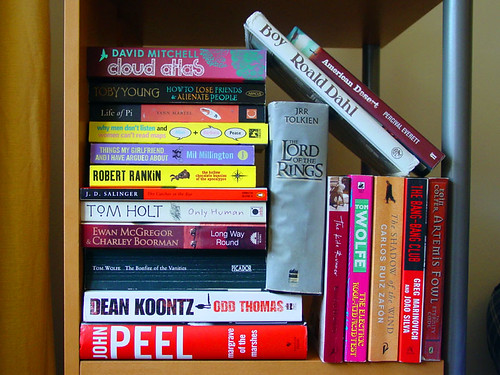
(picture licensed under a CC-BY licence from Ian Wilson)
The Productivity Commission has recommended that the laws enforcing the parallel importation restrictions (PIRs) be repealed.
If Australian publishers meet certain conditions, the Copyright Act 1968 effectively bestows upon them a monopoly in the local book market. Booksellers in Australia are restricted from imported a cheaper version of the book, and must buy it from an Aussie publisher instead (if available).
On the whole, this means that Australian publishers wield considerable market power, and arguably make supernormal profits as a result.
I just bought a book from The Book Depository (UK) for $34.40 plus a $2 international transaction fee on my credit card. The Book Depository charges in pounds and does NOT charge for shipping. At the local second hand book store across the road from my office, the same book goes for $40. At Borders further down the road, it's $59.95. Ouch.
Even if you accounted for foreign currency exchange differences, it seems to me that the Australian book retailers are charging a lot more for these books that our overseas counterparts. Presumably, that's because they have to buy it from Aussie publishers. When it comes to the relationship between booksellers and book publishers, booksellers appear to be the price takers.
An interesting quote from the Senator Carr on Printnet reveals something about these margins (or supernormal profits). He says (and presumably the printing/publishing industry agrees) that the margins the publishers make from best sellers are used to invest in more risky and unknown Australian authors. That is, the (supernormal) profits are used to invest in some authors which produce "cultural externalities" which would otherwise not be commercially successful.
Graeme Connelly (CEO of Melbourne Uni Bookshop) reckons "much of the argumentation by publishers (to the Productivity Commission) has frankly been rent-seeking."
Allan Fels made an interesting remark about the (then) Prices Surveillance Authority 1989 report recommending the repeal of PIRs on books. "It made a terrible mistake. It said there were two problems. Never give a politician two problems. Cos they'll take the easy one and solve it. We said that (a) there was a delay in books getting to Australia and (b) the prices were too high."
In 1991, amendments were passed requiring Australian publishers to supply the books within 30 days of publication in order to receive PIR protection. This solved the delay problem, but did not affect prices.
One other thing about Senator Carr: he thinks that the publishing and printing industry should be *tin foil hat on* "protected" *tin foil hat off* because we need the excess capacity in Australia to ensure the maximum dissemination of ideas. That is, despite the internet providing almost no barriers to dissemination, we still need books (and hence the decision makers and gatekeepers, publishers) to get the ideas out there.
I dunno about that, it might be true, it might not be. Something tells me, if we lift the PIRs, although the publishers can kiss some of their supernormal profits goodbye, they'll be just fine.
Let's maximise consumer surplus!!
Saturday, September 05, 2009
The Gospel and Intellectual Property (rival goods)
I've just finished reading "The Future of Ideas", a not so recent book by Lawrence Lessig. It talks about rivalrous goods and non-rivalrous goods.
A rivalrous good is one where my use of the good (say, a car), will rival your use of the same car. We cannot drive it at the same time. Most physical objects are rivalrous to some extent. A public park is non-rivalrous, until it gets really crowded, when my use and enjoyment of the park is negatively affected by your (and the thousand other people) use of the park. It will then become rivalrous.
Intellectual property, and knowledge in general, has the character of being non-rivalrous. If I learn something from you, say a recipe for chocolate brownies, you do not need to unlearn it. My use of the recipe does not rival your use of the recipe. Although, if we shared one oven, hopefully we can use the same recipe, otherwise the use of the oven will be rivalrous!
ANYWAY... I was thinking about the Gospel (aka Good News), and how people tell other people about Jesus. One of the great things about the good news of Jesus, is that, if I know it in my head, I can tell you all about Jesus. I do not need a leaflet, or a pamphlet or a bookmark to tell you about it. Leaflets may be finite (and their use rivalrous), but the gospel itself is not rivalrous. Millions of people tell millions of other people about Jesus all the time, and the gospel will never diminish in it power.
Interestingly enough, one might say that the act of telling people about Jesus, actually enhances my ability to tell more people. Like they say, practice makes perfect. Also, websites tend to be regarded as non-rivalrous, as MANY people can visit a website at a time. Although they do have their limits, as Denial of Service attacks can overwhelm a website by visiting it from many computers simultaneously.
So, non-rivalrous news (the good news about Jesus), from an almost non-rivalrous source (a website) - try Two Ways to Live.
A rivalrous good is one where my use of the good (say, a car), will rival your use of the same car. We cannot drive it at the same time. Most physical objects are rivalrous to some extent. A public park is non-rivalrous, until it gets really crowded, when my use and enjoyment of the park is negatively affected by your (and the thousand other people) use of the park. It will then become rivalrous.
Intellectual property, and knowledge in general, has the character of being non-rivalrous. If I learn something from you, say a recipe for chocolate brownies, you do not need to unlearn it. My use of the recipe does not rival your use of the recipe. Although, if we shared one oven, hopefully we can use the same recipe, otherwise the use of the oven will be rivalrous!
ANYWAY... I was thinking about the Gospel (aka Good News), and how people tell other people about Jesus. One of the great things about the good news of Jesus, is that, if I know it in my head, I can tell you all about Jesus. I do not need a leaflet, or a pamphlet or a bookmark to tell you about it. Leaflets may be finite (and their use rivalrous), but the gospel itself is not rivalrous. Millions of people tell millions of other people about Jesus all the time, and the gospel will never diminish in it power.
Interestingly enough, one might say that the act of telling people about Jesus, actually enhances my ability to tell more people. Like they say, practice makes perfect. Also, websites tend to be regarded as non-rivalrous, as MANY people can visit a website at a time. Although they do have their limits, as Denial of Service attacks can overwhelm a website by visiting it from many computers simultaneously.
So, non-rivalrous news (the good news about Jesus), from an almost non-rivalrous source (a website) - try Two Ways to Live.
Saturday, July 25, 2009
A new nerd convergence: MAKE and copyright
And you thought taxified Harry Potter titles were an unholy nerd alliance? As it turns out (from SMH) Amazon, who sell the Kindle and the e-books that are read on it, made a booboo. It turns out that they were selling books by George Orwell (like 1984), but after they were sold and downloaded to individuals' Kindle, it turned out they didn't have the rights to do so, and Amazon apparently snuck in, and deleted the e-books from everyone's Kindles and refunded the money, without decent notification.
Enter MAKE, a print and online magazine dedicated to DIY and lots of cool nerd stuff like electronics. For example, there are LOTS of Wiimote hacks on Make. KipKay, a popular online DIYer regularly makes videos for MAKE. Very cool - for example:
Anyway, it seems MAKE have published (through their blog) a "workaround" in order to get the Orwellian books back on the Kindle. "How?" you ask? One word, "copyright". In Australia, Orwell's books have entered the Public Domain because copyright in Australia (for literary works anyway) is life of author plus 50 years. In the US (where Amazon wasn't allowed to sell the books) the term is life of author plus 70 years. Nothing quite like a bit of copyright arbitrage. Of course, you actually HAVE to be in Australia to download the book (from an Aussie Uni site). A US resident will probably still be infringing copyright if they carry out the workaround unless they're in Australia.
Read the MAKE "workaround" here.
Enter MAKE, a print and online magazine dedicated to DIY and lots of cool nerd stuff like electronics. For example, there are LOTS of Wiimote hacks on Make. KipKay, a popular online DIYer regularly makes videos for MAKE. Very cool - for example:
Anyway, it seems MAKE have published (through their blog) a "workaround" in order to get the Orwellian books back on the Kindle. "How?" you ask? One word, "copyright". In Australia, Orwell's books have entered the Public Domain because copyright in Australia (for literary works anyway) is life of author plus 50 years. In the US (where Amazon wasn't allowed to sell the books) the term is life of author plus 70 years. Nothing quite like a bit of copyright arbitrage. Of course, you actually HAVE to be in Australia to download the book (from an Aussie Uni site). A US resident will probably still be infringing copyright if they carry out the workaround unless they're in Australia.
Read the MAKE "workaround" here.
Thursday, July 23, 2009
The Lazy Susan Code of Conduct

For those unaware, myself and others have authored the "Principles of Yum Cha", otherwise known as 'The Yum-Charter". Principle 23 refers to the 'Lazy Susan Code of Conduct'.
Here it is, a living document, if you will:
The Lazy Susan Code of Conduct
1. Subject to the below clauses, the Lazy Susan ('LS') shall be revolved as fast as is necessary to eat Yum Cha.
2. If someone is retrieving a dim sim from the LS, you shall not revolve the LS to the extent that the retriever has difficulty retrieving the dim sim.
3. As a matter of best practice, you shall wait until the retriever has retrieved their dim sim before revolving the LS.
4. Chilli sauce saucers shall be distributed evenly on the LS.
5. Depending on circumstances, empty bamboo baskets shall be placed in the centre of the LS, OR on a part of the table close to trolley traffic.
6. The LS shall not be spun so fast as to cause any objects on the LS to move, or any sauce in saucers on the LS to spill.
Any others that should be there?

Censordyne and the Parody/Satire Exception
In case you haven't already noticed, the independent political campaigning group GetUp! have launched a TV ad against the Australian Governments plans for mandatory ISP level filtering of the Internet. They use the likness of the packaging for Sensodyne toothpaste and have called it Censordyne "good, clean, internet censorship".
SMH story here.
Apparently, GlaxoSmithKlein (owner of Sensodyne), is not a fan of GetUp's use of the likeness of the toothpaste brand. They are even thinking of legal action, as they weren't consulted about the use of the brand.
The first thing I think of is the parody and satire exception to copyright infringement in section 41A of the Copyright Act 1968. Basically, you can reproduce a substantial part of a work, and avoid infringement if:
* it is for the purpose of parody or satire; and
* it is a fair dealing
I suppose the question is, (and I couldn't find anything in the Explanatory Memorandum in the amending Act which introduced s41A):
Does the parody have to be a poking fun at the thing being reproduced? That is, does the exception only apply if GetUp were in fact poking fun at the toothpaste rather than something else like a Government policy?
If you remembered the anti-ads by the Footy Show, those were poking fun at the ads themselves, so it's an obvious parody. But if you are using a toothpaste brand to poke fun at policy, is that covered by the exception?
Then you have to consider the satire part of the exception. The Australian Copyright Council (fact sheet G083v03) makes a distinction between parody and satire, and regards the satire exception to be more strict in the sense that more elements have to be present before one can regard it as "satire".
Food for thought.
SMH story here.
Apparently, GlaxoSmithKlein (owner of Sensodyne), is not a fan of GetUp's use of the likeness of the toothpaste brand. They are even thinking of legal action, as they weren't consulted about the use of the brand.
The first thing I think of is the parody and satire exception to copyright infringement in section 41A of the Copyright Act 1968. Basically, you can reproduce a substantial part of a work, and avoid infringement if:
* it is for the purpose of parody or satire; and
* it is a fair dealing
I suppose the question is, (and I couldn't find anything in the Explanatory Memorandum in the amending Act which introduced s41A):
Does the parody have to be a poking fun at the thing being reproduced? That is, does the exception only apply if GetUp were in fact poking fun at the toothpaste rather than something else like a Government policy?
If you remembered the anti-ads by the Footy Show, those were poking fun at the ads themselves, so it's an obvious parody. But if you are using a toothpaste brand to poke fun at policy, is that covered by the exception?
Then you have to consider the satire part of the exception. The Australian Copyright Council (fact sheet G083v03) makes a distinction between parody and satire, and regards the satire exception to be more strict in the sense that more elements have to be present before one can regard it as "satire".
Food for thought.
Subscribe to:
Posts (Atom)